

What OCX 2026 Made Clear: Eclipse RCP Is Moving Forward
Juan Farah on April 11th 2026
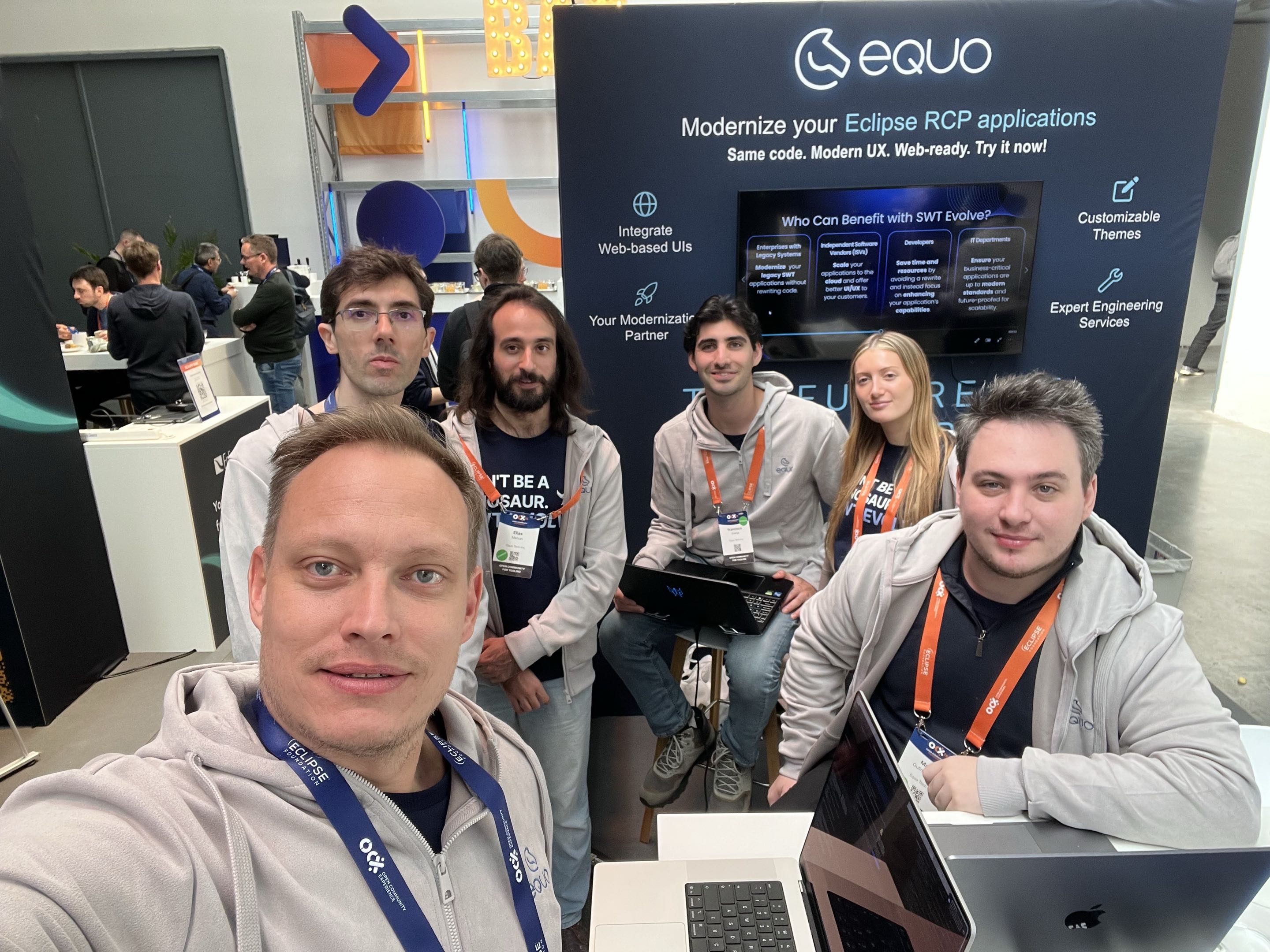
At OCX 2026, modernization stopped being an abstract discussion and became something teams could see for themselves. Companies came to our booth with real Eclipse RCP applications, tested them with SWT Evolve, and watched them run with a modern UI in seconds, without rewrites.
That immediate validation changed the tone of the event. Teams were not just asking whether Eclipse RCP could move forward; they were seeing their own software prove that it could. Real applications, real use cases, and real results made one thing clear: the path forward for Eclipse RCP is already here.
A Constant Flow of Conversations
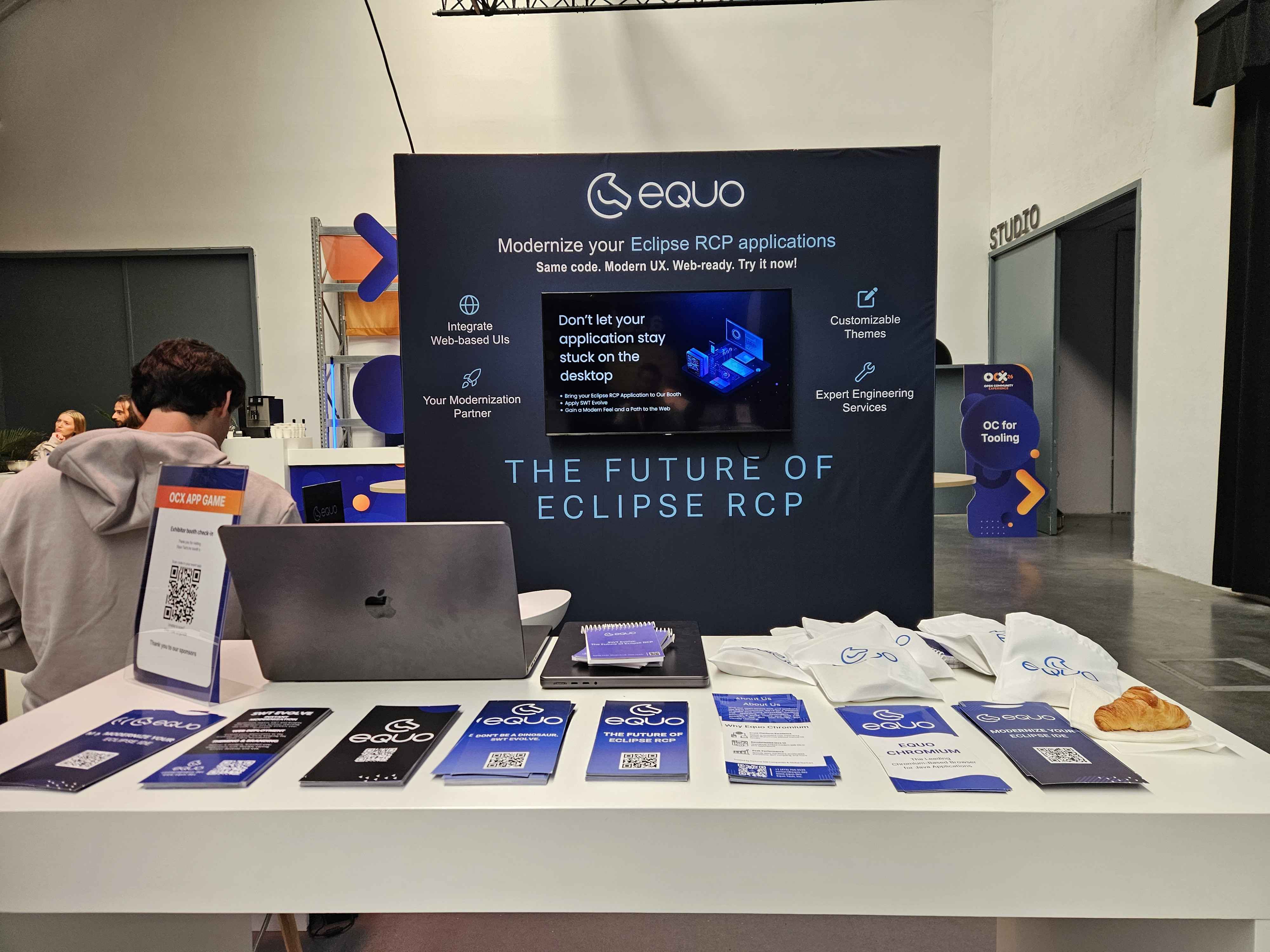
Throughout the event, our team connected with a wide range of developers, architects, and organizations working with Eclipse RCP applications. These weren’t isolated discussions or casual curiosity; they were focused, practical conversations about real systems in production, many of them critical to daily operations.
Despite coming from different industries and technical backgrounds, these teams shared a common challenge. They have built valuable, complex software over the years, and while they recognize the need to modernize, they are not willing to sacrifice what already works. Those conversations didn’t just highlight a problem; they reinforced the need for a different kind of solution.
Not Legacy. Not Done. But Still Stuck
There is a widespread assumption that Eclipse RCP belongs to a category of technologies that are slowly being phased out. However, what we observed at OCX tells a very different story.
Many teams are not simply maintaining their applications; they are planning to expand them. Some are actively investing in new features, while others are evaluating entirely new projects within the same ecosystem. This is not the behavior of an environment in decline. Instead, it reflects an ecosystem that still holds strong technical and business value but has been missing a practical way to evolve without starting over.
The Real Constraint Isn’t the Platform
In nearly every conversation, the same limitation appeared: rewriting an application from scratch is not a viable option. The cost, time, and risk involved are simply too high, especially for systems that already perform well and support critical workflows.
When the Message Clicked
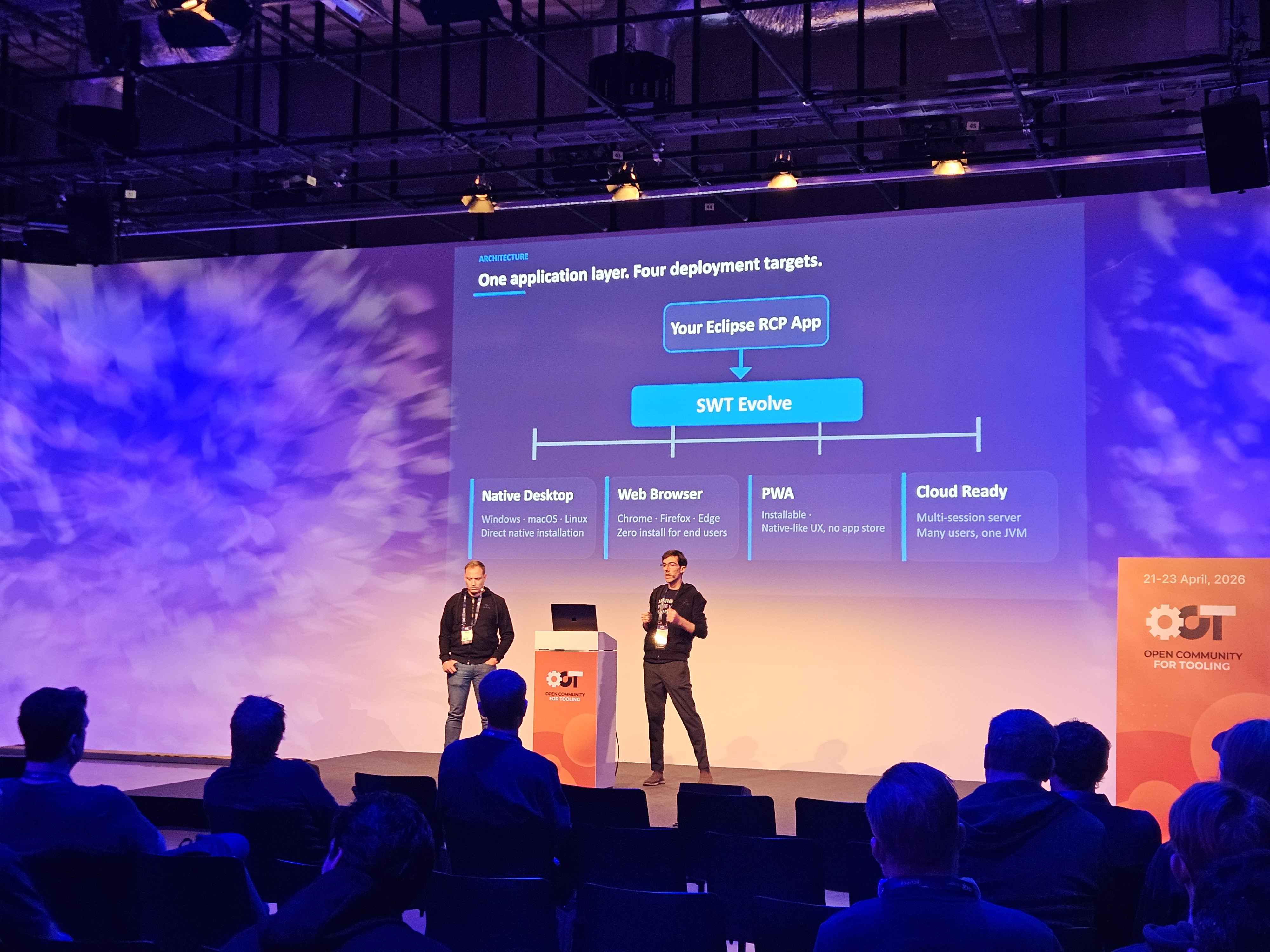
On the third day of the event, Sebastian Sampaoli and Guillermo Zunino presented how SWT Evolve enables teams to modernize Eclipse RCP applications instantly, bringing them to a modern UI and even to the web without requiring rewrites. What made the talk stand out was its technical depth: instead of high-level promises, it walked through how this is actually achieved, leveraging full SWT API compatibility, a modern rendering layer, and a runtime approach that allows existing applications to run unchanged while being visually and functionally transformed.
What followed was a clear shift in the nature of the conversations. The focus moved away from theoretical discussions and toward immediate possibilities. Teams that had previously considered modernization as a long-term, high-risk initiative began to see it as something tangible and achievable in the short term.
Turning Modernization into a Practical Path
At day one, many teams were evaluating difficult decisions. Some were exploring migration paths, while others were seriously considering full rewrites as the only viable way forward. The cost, risk, and complexity of these approaches were well understood, but for many, there seemed to be no alternative.
That changed during the event.
From the very first day, our booth became a constant point of activity. Teams didn’t just ask questions; they brought their own applications and tested them with SWT Evolve directly. What they saw was immediate: applications running with a modern UI, real systems evolving without rewrites, and results visible in seconds.
As the days progressed, and especially after the technical session, that momentum only grew stronger. More teams came, more demos were tested, and more assumptions were challenged. The idea that modernization required a full rewrite quickly started to break down.
What replaced it was something far more practical: a way to move forward without starting over.
By the end of the event, the plans had clearly shifted. What began as uncertainty around migration strategies turned into confidence in a new approach; one that teams could validate on their own, in real time. SWT Evolve made that shift possible.
What This Means Going Forward
The experience at OCX did more than validate our approach; it confirmed that a practical path to modernization is already here. The level of interest and urgency made it clear that teams are ready to move forward. What was missing was a way to do it without the cost and risk of a full rewrite.
SWT Evolve provides that path.
By building on what teams already have and extending it into modern experiences, web environments, and beyond, it turns modernization into something immediate and achievable, not a long-term, high-risk initiative.
Equo Chromium extends that even further, bringing modern web integration and advanced capabilities into environments that were previously limited to the desktop.
A Growing Momentum
What Equo at OCX ultimately made clear is that modernization is no longer a distant goal; it is something teams can achieve immediately. Throughout the event, real applications were brought, tested, and validated in real time, proving that existing Eclipse RCP systems can evolve into modern, high-quality user experiences, extend to the web, and move beyond the limitations of the desktop.
Teams didn’t just explore possibilities; they proved what was actually possible. Applications ran with modern UI/UX, evolved without rewrites, and were experienced across environments, from native desktop to web deployment. What once felt like a complex transformation became instantaneously achieved.
SWT Evolve turned what used to be a high-risk decision into a clear and practical path forward. What previously required years of planning, trade-offs, and uncertainty became something teams could validate on their own, in minutes, with real applications, real use cases, and real outcomes.
This wasn’t about future potential; it was about results. And those results created momentum. As more teams tested, validated, and shared what they experienced, interest grew rapidly, conversations deepened, and a clear direction emerged.
By the end of the event, that momentum was undeniable. Teams didn’t just see a new approach; they engaged with it, trusted it, and started moving forward with it.